
Your Restaurant Is Busy. So Why Are You Still Losing Money?
How a restaurant online ordering system can help Canadian restaurants protect margins, build direct customer relationships, and increase repeat orders.
A restaurant online ordering system can help independent restaurants protect margins by moving customers toward direct ordering, reducing dependence on third-party marketplaces, and creating opportunities to build customer loyalty and repeat purchases. For Canadian restaurants facing rising costs, the goal is not simply to generate more orders; it is to make more from each order and retain the customer behind it.
Walk into almost any Canadian independent restaurant on a Friday night, and things look promising. The kitchen line is humming, the takeout counter is stacked with bags, and delivery drivers are constantly cycling through the front door.
Yet, when the owner sits down at the end of the month to look at the books, the reality is devastating. The revenue numbers look healthy on paper, but the actual bank balance tells a completely different story.
If your restaurant is doing more volume than ever but your net margins are shrinking to zero, you are experiencing the Volume Illusion. In the current Canadian economic climate, higher top-line sales no longer guarantee survival. In fact, if you are relying on the wrong revenue streams, more orders might actually be pushing you closer to bankruptcy.
Canada's restaurant industry faces a severe structural squeeze, with reports tracking a net loss of 7,000 establishments in 2025 and an additional projected net loss of 4,000 restaurants in 2026, according to the [Dalhousie University Agri-Food Analytics Lab Report via Global News].
Key Causes of the Crisis
Rising Input & Labor Costs: Food, container, and supply costs rose 20% to 30% year-over-year, alongside higher minimum wages, rent, and insurance rates.
Shift in Consumer Spending: Inflation and cost-of-living pressures have forced diners to cut back on extras like appetizers, desserts, and alcohol, or switch to cheaper options.
Squeezed Margins: According to a report by [Restaurants Canada], 67% of Canadian eateries reported lower profits than the previous year despite higher overall sales. About 41% to 44% of food-service businesses are operating at a loss or barely breaking even.
Restaurants Canada reported that 67% of operators reported lower profitability than a year earlier, despite stronger-than-expected sales. The organization also reported that 44% of operators expected fewer guests and 44% were pessimistic about the year ahead.
Lets talk about margins, shall we? Historically, a well-run restaurant could count on a 5% to 7% net profit margin. Today, that margin has shrunk to an unsustainable 1% to 2% for many operators. You are working double the hours, taking on all the risk, and effectively paying to feed people without taking home a predictable paycheck yourself.
For context, restaurant profit margins commonly remain relatively thin. Toast's restaurant industry guide notes that restaurant profit margins can range from 0% to 15%, with the average restaurant profit margin generally falling between 3% and 5%.
The Tragic Flaw in Standard Industry Advice
When revenue stalls, the generic business advice given to restaurateurs usually falls into one of three buckets. Unfortunately, for an independent Canadian operator, these standard remedies are often a fast track to closing your doors.
Flawed Remedy 1: "Just raise your menu prices."
While necessary to keep up with inflation, aggressive price hikes hit a ceiling quickly. Today's consumer is highly price-sensitive. If a casual lunch starts pushing past $25 before tax and tip, guests don't just complain, they stop coming back.
Flawed Remedy 2: "Cut labor and shrink your portions."
Reducing service standards or noticeably shrinking portions ruins the guest experience. In a hyper-competitive market, a drop in quality guarantees your customers will defect to a competitor who respects their hard-earned dollars.
Flawed Remedy 3: "Lean heavily into Third-Party Delivery Networks."
This is the most dangerous trap in modern hospitality. Platforms like DoorDash, UberEats, and SkipTheDishes promise massive reach and a flood of new orders. What they rarely mention is that they charge upwards of 30% in commissions per order.
Let’s look at the math. If your food costs are 30%, labor is 30%, and overhead is 30%, your native margin is 10%. If a delivery app takes a 30% cut of the total bill, you lose money on every single order that leaves your kitchen. You are doing the prep, buying the ingredients, paying the kitchen staff, and cleaning up the mess all so a Silicon Valley tech giant can take the lion's share of the profit.
Worse yet, these apps hide your customer data from you. You don’t know who bought your food, you can’t market to them directly, and you are entirely at the mercy of an algorithm that could deprioritize your listing tomorrow.
For an independent restaurant, this is where online ordering for restaurants becomes more than a convenience. The ordering channel can determine how much control the restaurant has over its customers, data, margins, and future marketing opportunities.
The Brown Bag Crisis: The Death of the Customer Relationship
Beyond the devastating 30% commission, delivery networks break the fundamental premise of running a successful restaurant: owning your customer relationship.
Hospitality is a relationship business built on customer delight. You spend years perfecting your food, curating the ideal ambience, training staff to deliver impeccable service, and ensuring that every guest leaves happier than when they walked in. That emotional connection is your core business asset. It is what drives word-of-mouth, repeat visits, and deep customer loyalty.
Third-party delivery apps systematically destroy that connection.
When a guest orders your food through an app, the delivery network completely severs the relationship. Your brand is reduced to a thumbnail on a crowded screen, competing side-by-side with fifty other choices. Your hospitality, your service, and your unique personality are completely erased.
To the customer, the entire experience is reduced to a generic brown paper bag delivered by a stranger.
Zero Identity: If the food arrives lukewarm because the app driver took a multi-order route, the customer blames your kitchen, not the app.
Zero Ownership: You don’t know who bought your food, what they liked, or how to reach them again. The platform hoards the customer data, email addresses, and purchasing habits.
Zero Loyalty: You cannot engage these customers online or invite them back in-store because you have no way to speak to them. You are effectively paying a 30% tax to a platform that uses your food to build their customer base, leaving you with zero long-term retention.
If you do not own your customers, you do not own your business.
Reclaiming Your Business: From Transactions to Lifetime Value
In hospitality, an ancient truth still holds: when you take care of the customer, the business takes care of itself.
The fatal mistake most small business owners make today is viewing third-party delivery apps as a marketing tool. They aren't. They are a transactional trap. A delivery network treats your guests as one-off transactions on a digital conveyor belt. There is no memory, no relationship, and no long-term equity built for your brand.
To break out of the volume illusion, you must transition from a transactional mindset to a long-term customer lifecycle approach.
A restaurant online ordering system becomes valuable here because direct orders can create a repeatable path from first purchase to loyalty, retention, and future purchases. Instead of treating every order as an isolated transaction, the restaurant can build a direct relationship around the customer.
Rewarding a customer to engage with you directly isn't an added cost; it is an investment that pays massive dividends over the lifecycle of that relationship. When a guest orders directly from you, you aren't just saving a 30% commission on a single burger or pasta dish. You are unlocking the ability to bring that customer back 5, 10, or 50 times over the next year. This long-term customer value is the hidden engine of profitable restaurants and it's an engine that delivery apps deliberately disconnect.
The Afto Advantage: Total Lifecycle Engagement
You don't need to become a tech company to win your guests back. You just need the right ecosystem working for you behind the scenes.
At Afto, best ecommerce platform, we provide the exact suite of online tools and digital touchpoints required to turn casual app users into fiercely loyal regulars who engage with your restaurant online and in-store week after week.
Frictionless Direct Ordering: We build a premium, commission-free ordering experience directly on your website. Your guests get the exact convenience they crave, while your restaurant keeps 100% of the revenue and most importantly the customer data.
Smart Loyalty & Rewards Programs: Instead of a generic transaction, every direct order becomes an opportunity for your guests to earn points, unlock exclusive perks, and feel valued. We design rewards structures that incentivize the exact behaviors that grow your bottom line.
Automated Lifestyle Offers: Afto doesn't just sit there waiting for people to get hungry. Our system deploys a slew of smart engagement strategies like rainy-day specials, birthday rewards, and personalized "we miss you" offers straight to your customers' phones, keeping your kitchen top-of-mind.
The Omnichannel Bridge: We seamlessly connect your online presence with your physical dining room. Through smart QR code integrations, targeted in-bag marketing, and digital receipts, we make it effortless for a guest who discovered you on a screen to walk through your front doors for Saturday night dinner.
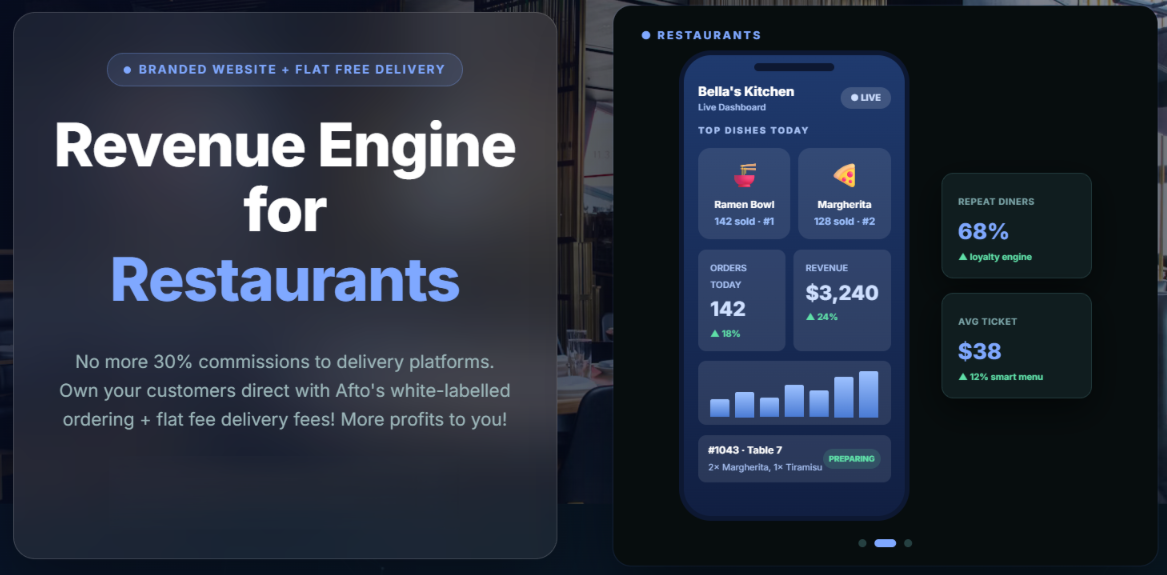
For restaurants evaluating online ordering systems for restaurants, the practical question is not simply whether online ordering exists. The better question is whether the system helps the restaurant retain the customer, understand buying behaviour, and create another direct purchase opportunity.
Focus on the Food. Let Afto Handle the Growth.
As a restaurant owner, you are likely playing the role of head chef, inventory manager, accountant, and janitor all at once. You don’t have thirty hours a week to build custom loyalty systems, manage customer databases, or run direct-order marketing campaigns.
That is exactly why we built the Afto End-to-End Managed Revenue Service.
We don’t just hand you a software login and wish you luck. Our team acts as your dedicated fractional growth department, building and managing the exact lifecycle systems required to claw back your margins and own your customer base.
You went into this business because you love food and human connection not to be a data manager for a tech platform. Let Afto handle the complexities of revenue engineering and customer ownership so you can focus on running a phenomenal kitchen.
For independent operators researching an online ordering system for restaurants Canada, the strategic goal should be simple: move more customers into a direct relationship, reduce unnecessary commission leakage, and create more opportunities for repeat business.
That is where direct online ordering for restaurants can become more than a convenience feature. It can become part of the restaurant's customer-retention strategy.
A well-designed restaurant online ordering system can therefore sit at the centre of that strategy: making ordering easier for customers while giving restaurants greater control over the relationship that follows the order.
Frequently Asked Questions
What is a restaurant online ordering system?
A restaurant online ordering system lets customers browse a restaurant’s menu, place orders, and pay through a direct digital ordering channel, typically the restaurant’s website or branded ordering page. Unlike a third-party marketplace, a direct system can help the restaurant build its own customer relationship and support loyalty and repeat-order strategies.
Why should restaurants use online ordering for restaurants instead of relying only on delivery marketplaces?
Online ordering for restaurants can give operators greater control over the customer experience and direct ordering relationship. The exact financial benefit depends on the restaurant’s pricing, order mix, technology costs, and third-party commission structure, but shifting appropriate customers toward direct ordering can reduce dependence on marketplace commissions.
What should I look for in online ordering systems for restaurants?
Look for a system that provides a simple mobile ordering experience, secure payment, menu management, order management, customer data access, loyalty integration, promotions, and analytics. Restaurants should also evaluate whether the system supports their existing POS and operational workflow.
Is an online ordering system for restaurants Canada different from one used elsewhere?
The core functionality is similar, but Canadian restaurants should evaluate payment options, taxes, delivery coverage, customer expectations, integrations, and local business requirements. A suitable online ordering system for restaurants Canada should fit the restaurant’s existing operations rather than forcing the operator into a completely different workflow.
How does direct online ordering for restaurants help customer retention?
Direct online ordering for restaurants creates an opportunity to connect an order with a first-party customer relationship. When combined with loyalty rewards, targeted offers, digital receipts, and follow-up campaigns, the restaurant can create more opportunities for customers to return directly instead of starting from a third-party marketplace each time.
Share this article
Help others discover this content
Ready to automate your business?
Join hundreds of businesses using Afto to streamline their operations and boost revenue.