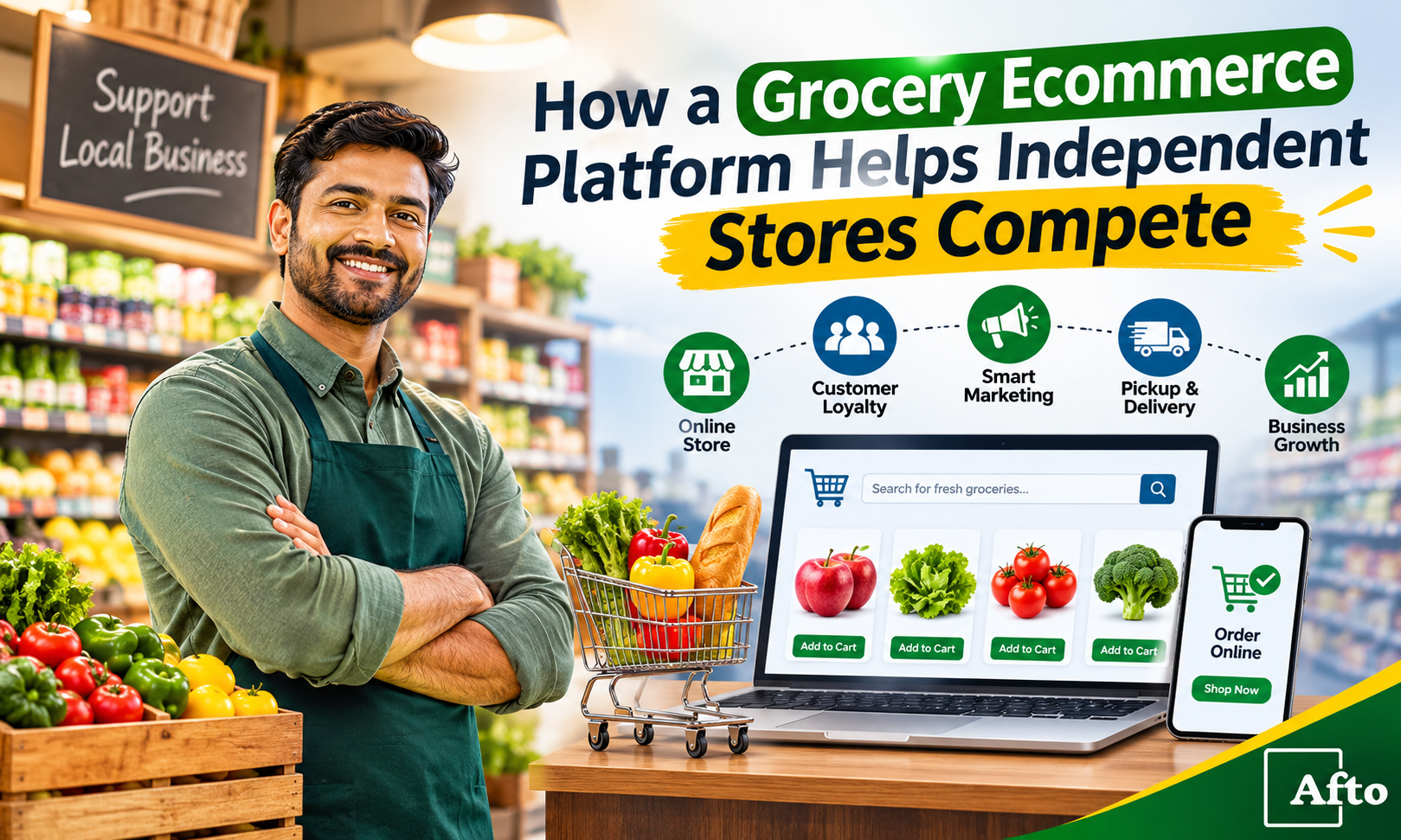
How a Grocery Ecommerce Platform Helps Independent Stores Compete
See how a grocery ecommerce platform helps independent grocery stores compete with big chains
Why are independent grocery stores struggling to compete?
The daily struggle of running an independent grocery store
Imagine starting your day at 6 AM. A shipment hasn't arrived. Two vendors need follow-ups. The weekend promotion still needs to go out. An employee has called in sick, inventory needs checking, and customers are already walking through the doors.
Meanwhile, a large supermarket chain down the street is offering aggressive discounts, sending personalized promotions through its mobile app, accepting online orders, and using sophisticated technology to optimize inventory and operations.
You know your customers. You understand your neighborhood. You've built relationships with families over generations. But competing is getting harder.
Margins are shrinking, operating costs are rising, and customers have more shopping options than ever. And while you're busy managing the daily operations of your store, your competitors are investing in technology, digital marketing, and customer loyalty to capture a greater share of the market.
Statistics Canada reported that food and beverage retailers generated $159.5 billion in operating revenue in 2024, while the subsector's profit margin was 6.9%, highlighting the scale and margin pressures within food retail. Statistics Canada — Annual retail trade, 2024
The uncomfortable reality is that being a good grocery store owner is no longer enough. You also need to be a digital retailer, a customer engagement expert, and an efficient technology-enabled operator.
For independent grocery stores, this is becoming an increasingly difficult balancing act.
There are four fundamental challenges driving this shift.
Why are independent grocery stores losing customers to large chains?
1. Losing customers and revenue to the giants of grocery retail
The Canadian grocery landscape is increasingly dominated by a handful of major players: Loblaws, Sobeys, Metro, Walmart, and Costco.
These retailers enjoy enormous advantages through their scale, purchasing power, distribution networks, and technology investments.
Consider supplier pricing. When a national supermarket chain negotiates with suppliers, it brings enormous purchasing volumes, long-term commercial relationships, and the ability to distribute products across hundreds of locations. This creates negotiating leverage and opportunities for better purchasing terms that smaller retailers often cannot match.
But their competitive advantage extends well beyond procurement.
Large retailers invest heavily in:
Private-label products that offer attractive prices and margins.
Loyalty programs that incentivize repeat purchases.
Mobile apps and ecommerce platforms that make shopping convenient.
Personalized promotions driven by customer purchase data.
Advanced inventory management and demand forecasting.
Digital advertising that keeps their brands visible.
Every one of these capabilities helps them attract customers, increase shopping frequency, and improve profitability.
Independent grocers face a different reality. Customers increasingly split their shopping across multiple retailers, discover promotions through supermarket apps, and choose competitors that offer greater convenience or better deals.
The challenge isn't simply losing a transaction. It's losing the customer relationship and the recurring revenue that comes with it.
Why is technology difficult for independent grocery stores to adopt?
2. The technology investment gap: Small businesses cannot compete with billion-dollar IT budgets
Behind every large supermarket chain is a sophisticated technology infrastructure connecting stores, suppliers, employees, inventory, marketing, and customers.
These retailers invest heavily in enterprise software, artificial intelligence, automation, and data analytics to answer critical questions:
Which products are likely to run out of stock?
Which customers are most likely to respond to a promotion?
How can inventory costs be optimized?
How can shopping frequency and average basket size be increased?
Where are operational inefficiencies affecting profitability?
For large chains, these capabilities are part of doing business.
For independent grocery stores, implementing the same technology can be prohibitively expensive.
A comprehensive ecommerce platform, mobile application, marketing automation system, employee management solution, loyalty program, and vendor management platform can require multiple software subscriptions, integration specialists, and ongoing technical resources.
The average independent grocer doesn't have an IT department, a data science team, or a dedicated digital transformation budget.
The problem isn't that independent grocers don't need technology. It's that enterprise-grade technology has traditionally been too expensive and complicated for them to adopt.
A modern grocery ecommerce platform can help close this gap by bringing multiple digital capabilities together rather than requiring a store owner to manage disconnected systems.
Why does your grocery store need to be visible online?
3. The digital marketing gap: Your customers are online, but is your store?
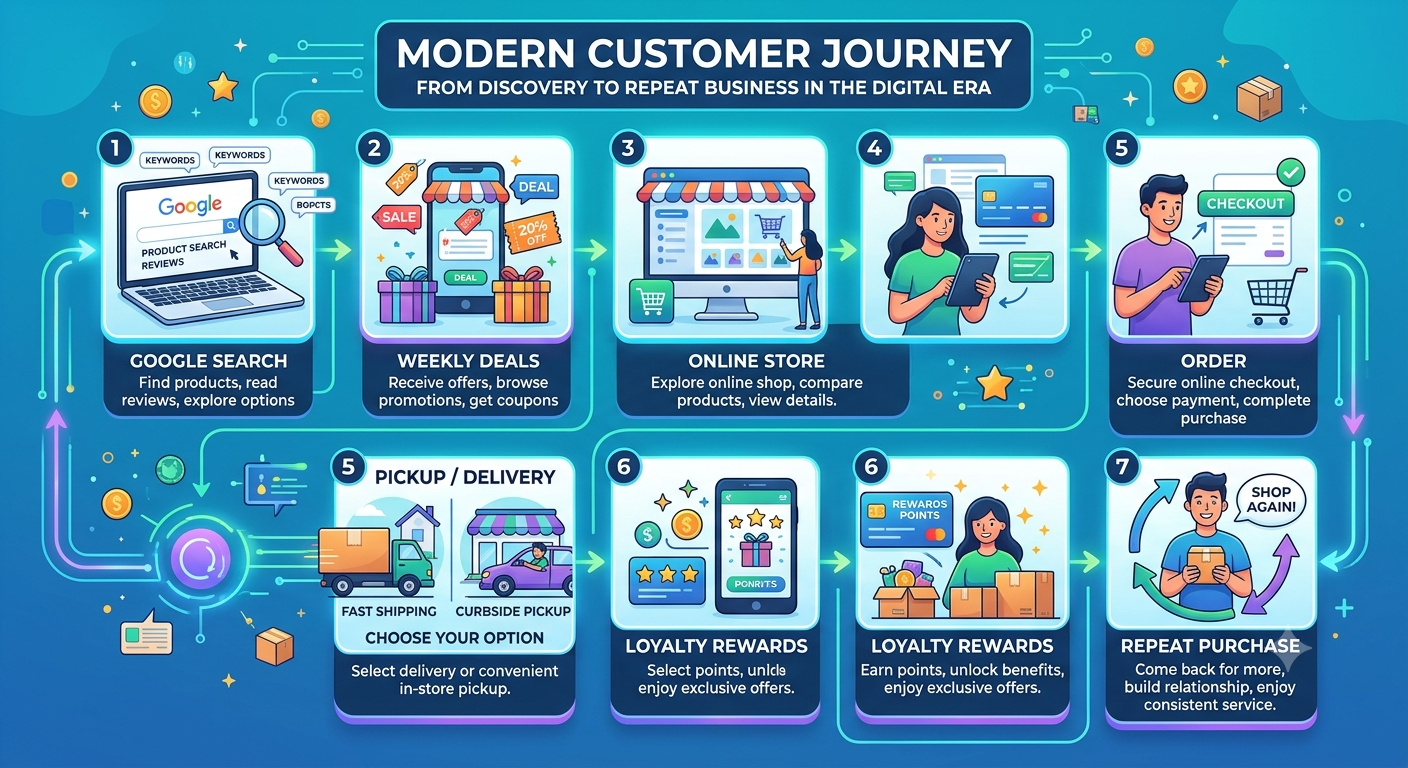
Customers today use Google to discover grocery stores, browse social media for promotions, compare products, and expect convenient online shopping options.
Statistics Canada reported that Canadian retail e-commerce operating revenue reached $73.7 billion in 2024, increasing 9.0% year over year, showing the continued growth of digital shopping in Canada. Statistics Canada — Annual retail trade, 2024
Digital visibility is no longer optional for retail businesses.
Yet many independent grocery stores still depend primarily on printed flyers, in-store posters, word of mouth, and occasional social media posts.
Modern digital marketing requires a consistent presence across search engines, social media, websites, and direct customer communication.
Imagine being able to:
Make your entire grocery catalog discoverable through Google searches.
Promote weekly deals through Facebook and Instagram.
Send personalized WhatsApp offers based on shopping preferences.
Highlight seasonal products, new arrivals, and special promotions.
Automatically engage customers with relevant product recommendations.
These activities require time, expertise, creative resources, and technology.
Most family-owned grocery stores don't have a dedicated marketing department. The owner is already managing vendors, employees, inventory, customers, and finances. Digital marketing becomes another responsibility that gets pushed aside.
Your customers are moving online. If your store isn't visible where they search, shop, and discover products, someone else will capture their attention.
This is where grocery ecommerce software can become more than an online ordering tool. It can become part of the store's broader customer acquisition and engagement system.
How can grocery stores reduce manual operational work?
4. Operational inefficiency: The store owner drowning in “busy work”
Running a grocery store involves hundreds of interconnected activities every day.
Inventory needs monitoring. Vendors need follow-ups. Purchase orders need to be placed. Deliveries need verification. Invoices need processing and payments need tracking.
Employees need schedules, task assignments, and performance oversight. Customers need assistance. Promotions need preparation. Bills need to be paid.
Without integrated technology, all this overhead lands directly at the lap of the owner!
Every process involves manual coordination, phone calls, spreadsheets, messaging apps, and repetitive administrative work.
The consequences are significant:
Employees spend time on administration instead of serving customers.
Inventory discrepancies and missed replenishment opportunities increase costs.
Manual processes create room for errors.
Owners have limited visibility into operational performance.
Business growth becomes increasingly dependent on hiring more people.
The most expensive cost is often overlooked: the owner's time.
Every hour spent chasing invoices, following up with vendors, or coordinating employees is an hour not spent acquiring customers, improving the store, or growing the business.
A grocery store should run on well-defined processes and systems, not on the owner's ability to personally manage every moving part.
What happens if independent grocery stores don't adapt to technology?
The death by a thousand cuts: Adapt or risk falling behind
Individually, these challenges might seem manageable. A few customers lost to competitors. Tighter supplier margins. Inconsistent marketing. Hours spent on manual administrative work.
But together, they create a dangerous cycle.
Less purchasing power puts pressure on margins. Reduced margins limit technology investment. Without technology, operational inefficiencies increase. Without digital marketing and customer engagement, repeat purchases weaken. As customers move elsewhere, revenue opportunities shrink further.
It becomes a death by a thousand cuts.
Independent grocery stores have something large chains often struggle to replicate: neighborhood relationships, local knowledge, cultural familiarity, and personal service.
But these advantages alone may not be enough to sustain a business in an increasingly technology-driven retail environment.
The time to adapt is now. Independent grocers must embrace digital transformation and automation, or risk a slow decline in relevance, revenue, and profitability.
The good news? Enterprise-grade technology and AI are no longer exclusively available to large corporations.
And this is where Afto- best ecommerce platform comes in.
How can a grocery ecommerce platform help an independent grocery store?
Introducing Afto: Imagine a grocery store that runs itself!
What if an independent grocery store could have its own online shopping platform, an automated marketing engine, a powerful customer loyalty program, an employee engagement system, and intelligent vendor management all working together?
What if the owner didn't need to manage five different software providers, hire a marketing department, or spend hours coordinating routine operations?
That's the vision behind Afto.
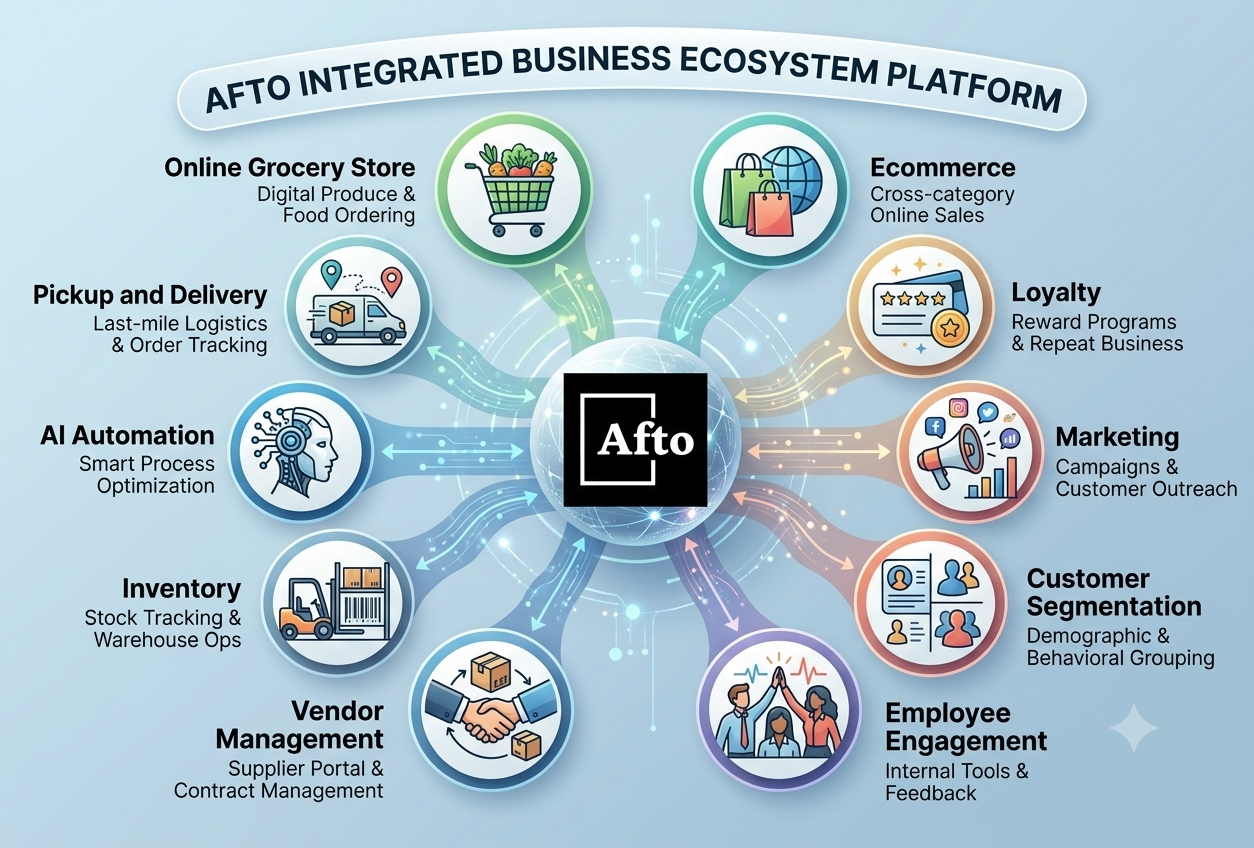
Afto brings enterprise-grade retail technology, digital commerce, and AI-powered automation to independent grocery stores through one integrated platform and a simple monthly subscription.
Our mission is to help small grocery businesses compete like large retailers, operate more efficiently, and grow profitably without the complexity and expense of building enterprise technology themselves.
How can you launch an online grocery store quickly?
1. Launch your online grocery store in days, not months
Your physical store has a geographic reach. Your digital store can extend that reach and make your products accessible to customers wherever they are.
Afto provides a professionally designed grocery ecommerce platform that allows independent grocers to establish an online shopping presence without lengthy and expensive technology projects.
With Afto, stores can:
Launch an online grocery storefront in days, not months.
Showcase their entire product catalog with images, descriptions, and pricing.
Allow customers to browse and place orders online.
Accept secure online payments.
Offer pickup and home delivery.
Promote weekly specials, bundles, and seasonal products.
This isn't simply about putting products online. It's about creating a new revenue channel, attracting new customers, and giving existing customers another convenient way to shop.
For a store evaluating the best grocery ecommerce platform, these capabilities are important because the platform should support the entire shopping journey rather than simply display products online.
How can grocery stores use AI marketing and loyalty to increase repeat purchases?
2. An AI-powered marketing automation services and loyalty campaign engine that brings customers back every week
Getting customers to discover your store is only half the battle. The real opportunity lies in turning first-time shoppers into loyal, repeat customers.
Afto combines automated digital marketing, personalized customer engagement, and an intelligent loyalty engine to help grocery stores build lasting customer relationships.
Our fully managed marketing service helps stores maintain an active digital presence across search engines, social media, and direct communication channels.
This includes:
Catalog SEO: Make products and categories discoverable through Google and relevant online searches.
Social media marketing: Promote weekly flyers, new arrivals, seasonal products, and special offers across social platforms.
Automated campaigns: Deliver weekly promotions, personalized recommendations, and targeted offers through WhatsApp, email, and SMS.
Customer segmentation: Use shopping patterns and purchase history to reach customers with relevant promotions.
But what truly makes the difference is Afto's customer engagement and loyalty engine.
Imagine a customer visiting your store every Saturday. Every visit becomes an opportunity to reward and engage them.
Every purchase earns loyalty points. Every visit can unlock special coupons. Personalized rewards encourage customers to try new products, increase their basket size, and return for their next shopping trip.
Afto helps stores build structured loyalty programs with:
Points earned on purchases.
Coupons and exclusive member discounts.
Personalized product offers.
Rewards and incentives for repeat visits.
Special promotions for loyal and high-value customers.
Targeted campaigns based on shopping preferences.
Think about the possibilities. A customer who regularly buys fresh vegetables receives a personalized produce offer. A frequent snack buyer gets a weekend promotion. A loyal customer receives a special coupon encouraging another visit.
Instead of sending the same generic flyer to everyone, your store can create relevant reasons for individual customers to return.
Every visit matters. Every purchase is an opportunity to reward. Every customer interaction is a chance to build loyalty.
The goal is simple: keep your store connected to customers throughout the week, incentivize repeat shopping, and make your grocery store their preferred weekly destination.
How can grocery stores improve employee productivity?
3. Employee engagement: Build a more productive workforce
Employees are among the most important assets of a grocery store. But managing schedules, attendance, responsibilities, and communications manually creates unnecessary overhead.
Afto's Employee Engagement System brings greater structure, visibility, and accountability to everyday store operations.
Store owners can manage employee schedules, shift assignments, attendance, task allocation, communications, and performance tracking through a centralized system.
Employees know what needs to be done, managers have better operational visibility, and owners spend less time coordinating routine activities.
The objective isn't simply to monitor employees. It's to help build a productive workforce focused on customer service, store operations, and revenue growth.
How can grocery stores automate vendor and inventory management?
4. Vendor and inventory management: Automate the operational backbone
Managing multiple suppliers, thousands of products, purchase orders, deliveries, invoices, and payments is one of the most time-consuming responsibilities of an independent grocer.
Afto's Vendor Management System is designed to streamline this entire workflow.
Centralized vendor management: Maintain vendor records, supplier relationships, product mappings, and purchasing history.
Stock monitoring: Track inventory and identify products requiring replenishment.
Purchase order automation: Simplify ordering and reduce repetitive vendor follow-ups.
Invoice processing: Digitize invoices, match them against purchase orders and received goods, and identify discrepancies.
Payment management: Track outstanding invoices, payment obligations, and vendor reconciliation.
By bringing these workflows together, Afto helps reduce administrative overhead, improve inventory visibility, and free up valuable time for store owners.
Over time, AI-powered insights can further help identify purchasing patterns, anticipate replenishment needs, and improve inventory decisions.
Vendor management should be a streamlined business process, not a full-time job for the grocery store owner.
How can independent grocery stores access enterprise-grade technology?
5. Enterprise-grade technology at a fraction of the cost
Can an independent grocery store actually afford all this?
Historically, implementing ecommerce, marketing automation, employee management, loyalty, and vendor management meant purchasing multiple software subscriptions, hiring specialists, and employing additional people to manage everything.
For a small business, that simply isn't practical.
Afto takes a different approach.
We bring these capabilities together through one integrated platform, backed by managed digital marketing services and AI-powered automation.
Online commerce. Customer engagement. Loyalty and rewards. Employee management. Vendor and inventory workflows. AI automation.
All available through a simple monthly subscription, at a fraction of the investment traditionally associated with enterprise retail technology.
No billion-dollar IT budget. No large internal technology team. No complicated enterprise implementation.
Just the technology and services an independent grocery business needs to compete and grow.
What is the future of independent grocery retail?
The future of grocery retail belongs to businesses that embrace technology
Independent grocery stores are more than retail businesses. They are neighborhood institutions built on trust, relationships, and generations of community service.
But the next generation of grocery retail will demand more.
Customers will expect convenient digital shopping. Marketing will become increasingly personalized. Loyalty will be driven by meaningful rewards and engagement. Store operations will become more automated. AI will play a growing role in managing inventory, customers, employees, and business decisions.
These capabilities should not belong exclusively to the largest supermarket chains.
At Afto, we believe a small grocery store on a neighborhood street deserves access to the same sophisticated technology that powers a modern supermarket — without needing the same resources to operate it.
We are building a future where digital channels bring customers through the door, loyalty programs keep them coming back, AI takes care of repetitive tasks, employees are better organized, vendors are easier to manage, and store owners have more time to focus on growing their businesses.
Imagine a store that runs itself. Imagine every customer visit creating an opportunity for another purchase. Imagine competing with the giants without having to become one.
That's the future Afto is building.
Frequently Asked Questions
What is a grocery ecommerce platform?
A grocery ecommerce platform like Afto allows a grocery store to create an online storefront where customers can browse products, place orders, make payments, and choose options such as pickup or delivery.
Why does an independent grocery store need a grocery ecommerce platform?
A grocery ecommerce platform gives independent stores an additional digital sales channel while making it easier for customers to shop online, discover promotions, and interact with the store.
What should I look for in the best grocery ecommerce platform?
The best grocery ecommerce platform should support online product catalogs, payments, pickup and delivery, promotions, customer engagement, loyalty, and integrations that reduce manual work.
How is grocery ecommerce software different from a regular ecommerce platform?
Grocery ecommerce software is designed around grocery-specific requirements such as large product catalogs, frequently changing inventory, promotions, pickup and delivery, customer loyalty, and repeat purchasing.
Can grocery shopping software help increase customer loyalty?
Yes. Grocery shopping software can support loyalty programs, personalized promotions, customer segmentation, rewards, and targeted communications that encourage customers to return and shop more frequently.
Share this article
Help others discover this content
Ready to automate your business?
Join hundreds of businesses using Afto to streamline their operations and boost revenue.